Social hierarchy and snobbery
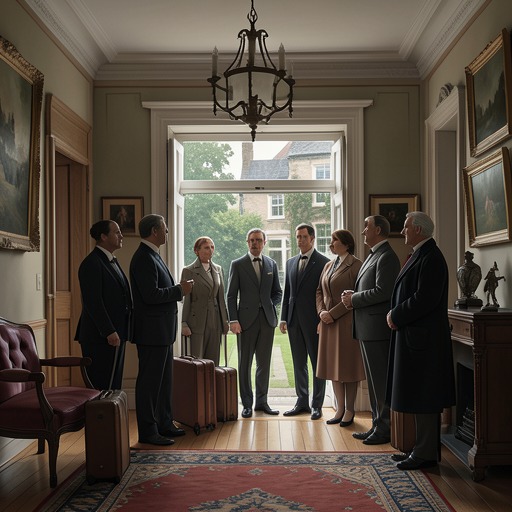
In Search of Lost TimeSocial hierarchy and snobbery are enacted through the minute procedures of social life: who is invited, where guests sit, how names are pronounced, which artistic judgments count, and what courtesies imply. Rank is neither simply possessed nor merely declared. It must be recognized by others, and the novel repeatedly shows recognition being won, withheld, misunderstood, or performed with comic excess.
Hospitality as rank and obligation
At Féterne, the elderly Marquise de Cambremer’s high birth and wealth place her above the region’s minor nobility, yet she attends even the least distinguished local gatherings because she fears disappointing those who have invited her. Her willingness to accept invitations is not evidence that she considers every host her equal. It reflects an obligation of personal kindness that can conflict with the distinctions her position implies. The hosts, meanwhile, eagerly await the arrival of her barouche: its appearance outside a watchmaker’s or chemist’s shop signals that she is on her way and relieves days of uncertainty about whether their party will receive her.
Her presence changes the meaning of the gathering. Hosts who may have regarded her as too obliging when she attended their less prestigious neighbours’ parties recover their sense of her family’s antiquity and the splendour of her house as soon as she enters their own. They anticipate converting her attendance into a notice in the Gaulois, and they watch for the report to appear, hoping that her name will head the list. The Marquise herself is pleased for the public to know that she came. Hospitality thus becomes an exchange: she offers attendance and distinction, while hosts seek social recognition that extends beyond the room and into print.
The contrast with the young Mme de Cambremer makes clear that rank is also performed through selective courtesy. Meeting the narrator as a friend of Robert de Saint-Loup, who has described him as a friend of the Guermantes, she greets him with a radiant smile. The narrator understands that, had she encountered him through her brother Legrandin instead, she would likely have offered the curt, unpleasant politeness she reserves for people of lower standing. Her warmth responds less to the visitor himself than to the social connections she associates with him.
Invitations, recognition, and social performance
At the Princesse de Guermantes’s parties, even the arrangement of chairs expresses a distinctive theory of social life. The Princess has groups of guests seated with their backs sometimes turned to one another, then moves between the groups and draws people into new conversations. She makes introductions, creates openings for guests to approach one another, and gives each group a portion of her time. Her movements appear spontaneous, but together they display the art of entertaining as a form of high social competence: the hostess seems to choose each encounter by inclination while systematically attending to the whole company.
The invitations themselves remain uncertain and consequential. The narrator infers that the Princess had not discussed him with Palamède de Charlus, since otherwise he would not have been invited. The episode reveals how access to a prestigious gathering can depend not just on a hostess’s independent judgment but on a powerful guest’s exclusions. Society also measures people by this access: those invited may be cherished, while those omitted may be resented, and the Princess’s sudden parties can surprise people on both sides of the invitation line. The social event is therefore less a stable community than a shifting distribution of visibility and favor.
At the entrance, the usher turns recognition into a public ceremony. The Duc de Châtellerault has previously presented himself to him as an Englishman, concealing his identity during a private encounter in the Champs-Élysées. When the Duke arrives at the Princess’s house and gives his real name, the usher recognizes him and announces him with the full title he can supply. The Duke realizes that his identity has been exposed to the usher, even though the assembled guests do not know the secret behind their recognition. The scene separates public rank from private knowledge: the announcement magnifies the Duke’s status while simultaneously revealing how vulnerable he is to someone who has learned who he is.
The narrator, by contrast, experiences the announcement of his own name as a threat of exposure. He would prefer the usher to speak quietly, but the name is called out with force. In the same entrance ritual, therefore, an aristocrat’s title is celebrated while an ordinary guest fears being made conspicuous. Social hierarchy is not only a question of who belongs; it governs how loudly belonging, or its uncertainty, is made public.
Speech, names, and the acquisition of distinction
The young Mme de Cambremer’s investment in aristocratic speech shows how social identity can be pursued through language. She has learned to pronounce prestigious family names in the manner she takes to be correct in elevated circles, suppressing sounds that other speakers retain. Her fascination with the form Ch’nouville belongs to a broader ambition to master the speech conventions associated with families such as Uzès and Rohan. What initially astonishes her becomes, through repetition, a distinction she can use to correct others.
This linguistic ambition is bound to marriage and social aspiration. The young woman had once found particular pleasure in pronouncing these names, and the narrator says that the prospect of doing so helped determine her choice of husband. Marriage to M. de Cambremer gives her access to some of the family connections she sought, but not the circle she had imagined. The phrases she dreams of using—to introduce someone to an illustrious aunt or invite them to dine with the Uzès—stand for a level of social access that her marriage has not fully secured. Her pronunciation can imitate a code of belonging, but it cannot by itself provide the relationships that make the code effective.
The narrator’s account also distinguishes her present resentment from the explanation supplied by her husband’s relatives. Those relatives claim that she is tormented by having been born a Legrandin. The narrator rejects this account: she has, he says, forgotten that fact and is offended when he recalls it, rather than openly lamenting it. The disagreement itself exposes the social work of gossip. The provincial ladies’ claim may serve their own purposes when addressing commoners, allowing them to present their hospitality as a condescension from people of superior birth; it does not necessarily reveal the young woman’s actual feelings.
The pronunciation of Saint-Loup provides another small test of whether a social marker will be recognized as distinction or dismissed as error. Mme de Cambremer says Saint-Loupe, and an admirer imitates her. Later, both return to Saint-Lou, after people of greater social prestige have indicated that the final consonant should not be pronounced. A supposed sign of originality becomes a solecism once the relevant social circle rejects it. The change shows how precarious linguistic distinction can be: its value depends not on the speaker’s conviction but on the judgment of those whose authority she seeks.
Rank, politeness, and contested authority
The Princesse de Parme’s conduct in the Balbec hotel illustrates the persistence of aristocratic etiquette beyond a noble household. She tips Aimé, the wine waiter, and the lift-boy, offering each a smile and friendly words. Her manner treats the hotel staff as though they were attending on her in a private country house, and it gathers them around her in conversation. Other hotel guests, not knowing who she is, misread her conduct and assume she is simply a familiar local visitor. The episode places two interpretations side by side: to the Princess, benevolent attention is consistent with the habits of a sovereign; to onlookers, the same attention obscures her rank.
The narrator links her unforced manner to a courtly convention that the sovereign is at home wherever she goes. The custom that a host carry his hat in his own house to acknowledge the Prince’s presence survives, in his account, as an obsolete expression of that principle. The Princess does not need to state the rule. Her manner of rewarding staff and speaking to them as individuals expresses an ingrained sense of authority and hospitality, even in surroundings where the convention is unfamiliar.
At La Raspelière, Palamède de Charlus makes hierarchy explicit. When M. de Cambremer offers him a seat, the Baron interprets the gesture as an acknowledgment of the precedence owed to a prince and refuses the chair with emphatic familiarity, insisting that such deference belongs to princes of the blood. A simple act of politeness is thereby recast as a question of rank. The performance depends on an asymmetry: M. de Cambremer may have meant only to be courteous, while Charlus uses the moment to assert the social meaning he prefers.
Charlus later supplies an extended genealogy of precedence to Morel and M. de Cambremer. He recalls a family claim to the Duchy of Aumale and recounts disputes over kneeling cushions, raised ushers’ batons, and the order in which members of princely houses could approach the King. He presents these precedents as proof that his family’s right to be first at court was earned through its history and military service. The precision of the examples gives the claim the form of historical argument, but the occasion also makes its purpose apparent: the genealogy is delivered in Morel’s presence, and the narrator understands the display as intended for him. Rank functions here both as inherited history and as a message directed at a particular audience.
Taste, status, and unstable judgments
Artistic taste also serves as a means of distinction, but the novel resists treating taste as a reliable measure of either intelligence or rank. The older Marquise de Cambremer’s enthusiasm for music is expressed with exuberant physical gestures and extravagant praise; her appreciation of a view can alter the narrator’s sense of what the seaside landscape offers. Her response is not presented simply as a social pose. It has the power to teach him to see a landscape as a seascape, even as the young Mme de Cambremer remains cold toward her mother-in-law and distrusts the affability that might lower the family’s standing in others’ eyes.
The narrator also notices that conversation tends to sink to the level of what speakers believe will please their companions. With Mme de Cambremer-Legrandin, he instinctively adopts the kind of language he imagines her brother would use, describing the gulls as resembling water-lilies. This mutual accommodation is a social performance: each speaker reaches for the qualities they think will be appreciated, rather than speaking solely from an unexamined personal standard. Yet the exchange is not reducible to snobbery, since the older Marquise’s response to the sea genuinely expands the narrator’s perception.
Across these scenes, distinction remains both powerful and unstable. A barouche can make a modest gathering appear socially important; a name can be pronounced as a badge and then corrected as a mistake; a seat can become an argument about princely precedence; a title can magnify a guest while exposing a concealed identity. Rank is reproduced through ritual and recognition, but every ritual leaves room for misreading, ambition, and performance. Social hierarchy endures not because its signs are self-explanatory, but because people continually interpret and contest them.